BGP Route Advertisement with Kube-OVN on Harvester
In multi-tenant or hybrid environments, Kubernetes workloads (VMs, pods, and services) need to be reachable from the broader network. The traditional answer is static routes scattered across every upstream router, which breaks as soon as the cluster grows or moves. BGP solves this cleanly : the cluster advertises its own CIDRs dynamically, and every router learns them automatically.
This post documents a proof-of-concept lab that validates BGP route propagation between Kube-OVN's built-in speaker, two VyOS sagitta (1.4.x) routers, and a Harvester cluster, all running as Hyper-V VMs on a single Windows host.
The end-state we are aiming for is a successful ping from router-02 to a Kube-OVN pod IP, with every hop learned via BGP :
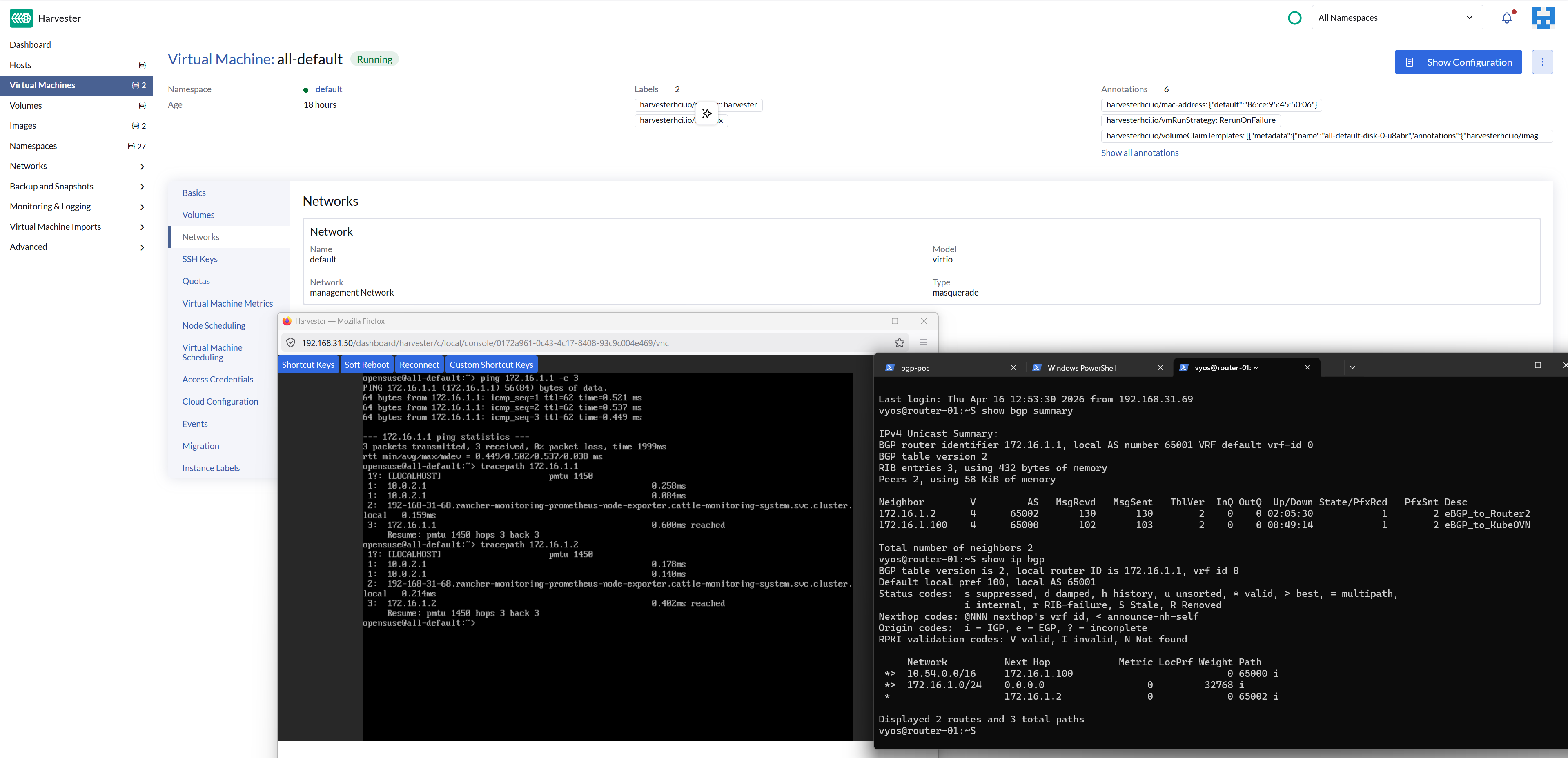
The lab
Three nodes span three autonomous systems, and router-02 reaches Kube-OVN prefixes transitively through router-01 to validate multi-hop eBGP propagation :
| Node | Role | AS | BGP IP |
|---|---|---|---|
hv-01 |
Harvester, Kube-OVN speaker, advertises the pod CIDR and annotated service IPs | 65000 | 172.16.1.100 |
router-01 |
VyOS, direct peer with hv-01 and router-02 |
65001 | 172.16.1.1 |
router-02 |
VyOS, learns Kube-OVN routes via router-01 |
65002 | 172.16.1.2 |
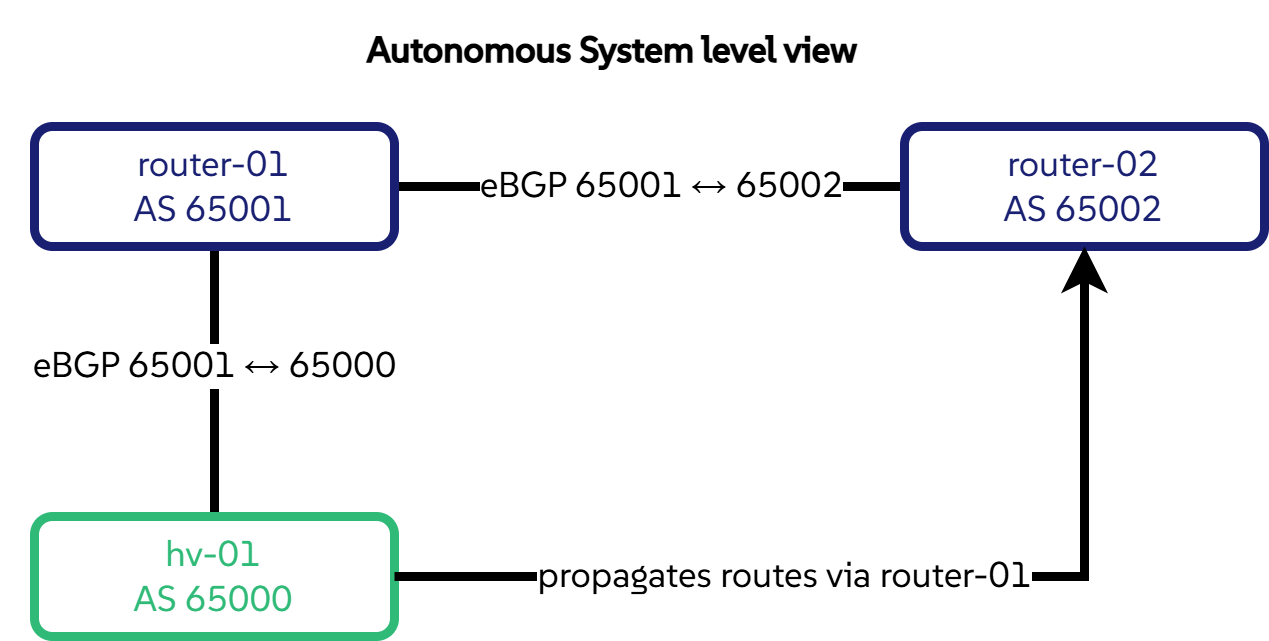
BGP peering runs over a dedicated 172.16.1.0/24 network (VLAN 100), isolated from the management network, mirroring a realistic production design. All configuration files and manifests are in github.com/coulof/bgp-poc .
Enabling Kube-OVN BGP on Harvester
Harvester ships Kube-OVN as an optional add-on.
Navigate to Addons in the Harvester UI and enable kubeovn-operator to get Kube-OVN v1.15.4 with --non-primary-cni-mode=true.
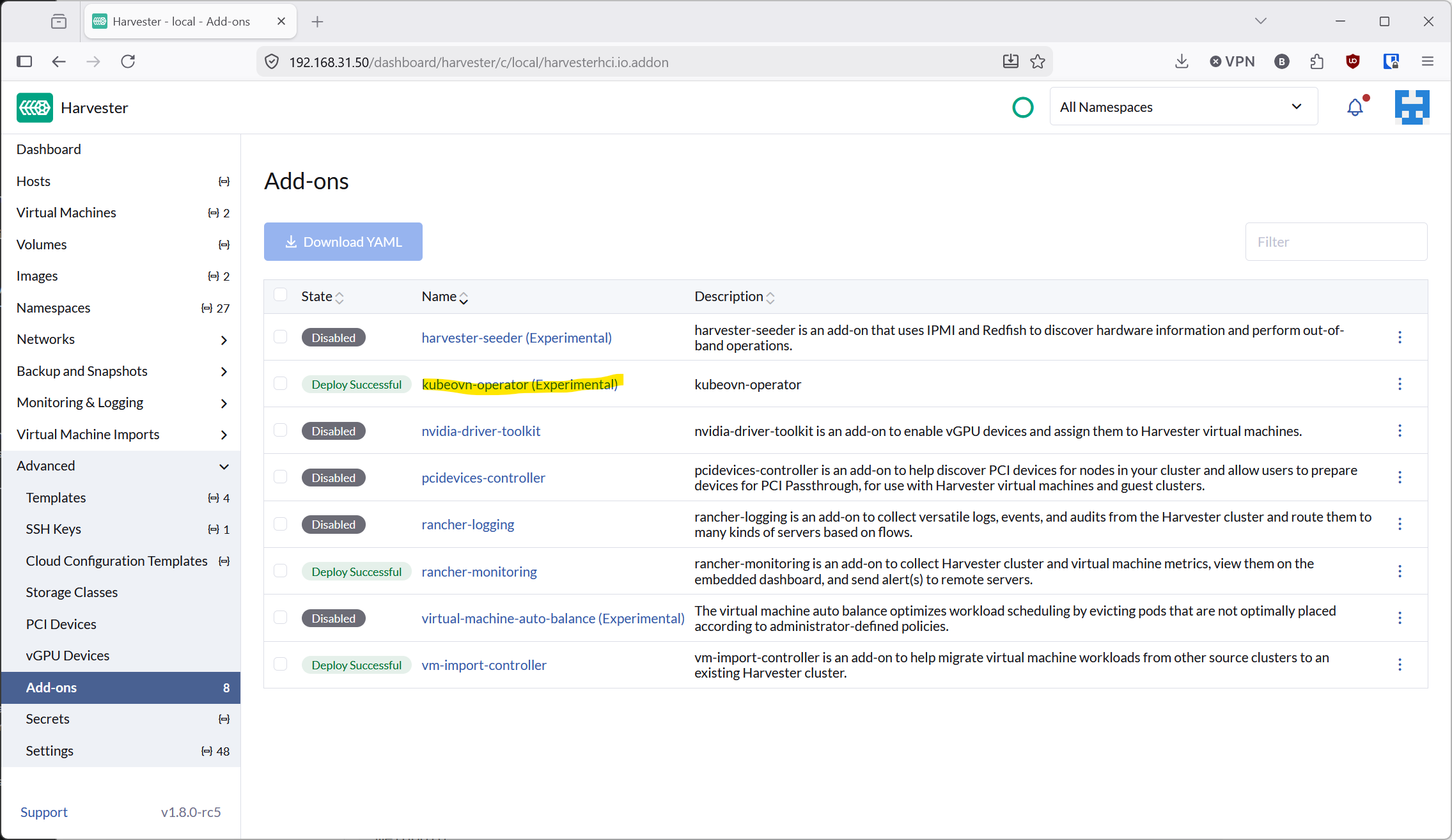
Once enabled, verify that the core Kube-OVN pods are healthy before continuing :
kubectl -n kube-system get pods -l app=kube-ovn-controller
kubectl -n kube-system get pods -l app=ovs
kubectl get subnets.kubeovn.io
Hyper-V prerequisites : two non-obvious settings
VLAN trunking
Hyper-V drops 802.1Q-tagged frames by default.
Both VyOS routers use sub-interfaces (eth1 vif 100), and Harvester's Kube-OVN bridge expects tagged frames on VLAN 100.
The BGP-Switch adapter on every VM must be set to trunk mode :
foreach ($vm in "router-01", "router-02", "hv-01") {
    Get-VMNetworkAdapter -VMName $vm |
        Where-Object { $_.SwitchName -eq "BGP-Switch" } |
        Set-VMNetworkAdapterVlan -Trunk -AllowedVlanIdList "100" -NativeVlanId 0
}
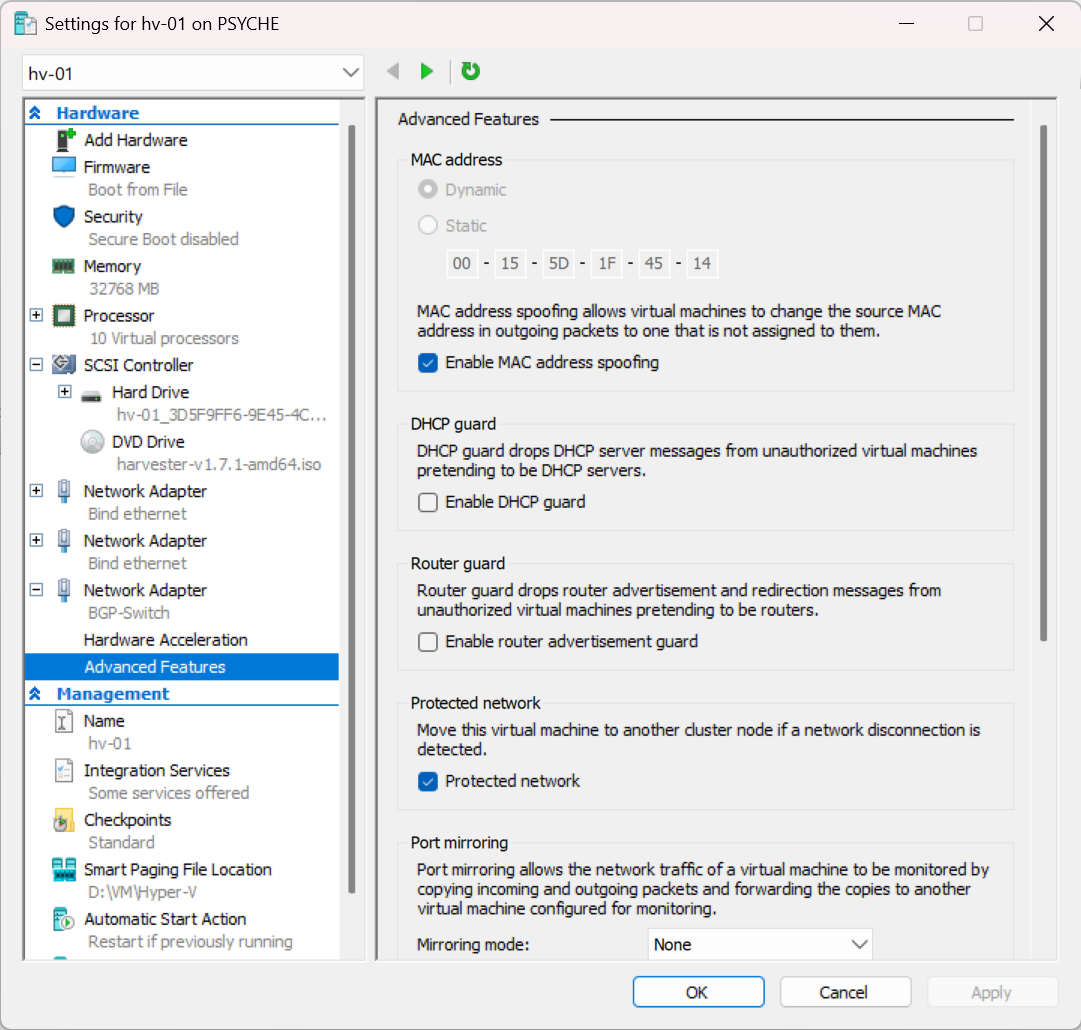
MAC address spoofing
Harvester bridges eth2 into an OVS bridge (bgp-br) with its own MAC address, different from the VM adapter.
Hyper-V's default security policy silently drops frames with a mismatched source MAC.
Enable spoofing on hv-01's BGP adapter :
Get-VMNetworkAdapter -VMName "hv-01" |
    Where-Object { $_.SwitchName -eq "BGP-Switch" } |
    Set-VMNetworkAdapter -MacAddressSpoofing On
Warning
Both settings fail silently : the VM boots fine, BGP sessions stay in Idle, and no error message points at the hypervisor layer.
Harvester BGP interface setup
Three CRDs configure the BGP peering interface on hv-01 :
ClusterNetwork: declares a logical network (bgp) backed byeth2VlanConfig: bindseth2as an active-backup bond ; Harvester automatically buildseth2 → bgp-bo → bgp-brHostNetworkConfig: assigns172.16.1.100/24on VLAN 100 with cluster-managed persistence across reboots
kubectl apply -f clusternetwork.yaml -f vlanconfig.yaml -f hnc.yaml
Full manifests are in the repository .
Blocker
Do not proceed until L3 is confirmed from hv-01 :
ping -c3 172.16.1.1   # router-01
ping -c3 172.16.1.2   # router-02
Kube-OVN BGP speaker
Harvester's bundled Kube-OVN v1.15.4 does not include the BgpConf / BgpPeer CRDs.
BGP configuration goes through container args on the kube-ovn-speaker DaemonSet instead.
Label the node, deploy the speaker, then annotate the subnet to advertise :
kubectl label nodes hv-01 ovn.kubernetes.io/bgp=true
kubectl apply -f speaker.yaml
kubectl annotate subnet ovn-default ovn.kubernetes.io/bgp=true
Single neighbor per speaker
A Kube-OVN speaker DaemonSet configured via container args accepts a single --neighbor-as value : a limitation of this deployment shape, not of BGP itself.
The speaker here peers with router-01 (AS 65001) ; router-02 learns Kube-OVN routes transitively through router-01.
A second speaker instance would be needed to open a direct session with router-02 (AS 65002).
Newer Kube-OVN releases ship BgpConf / BgpPeer CRDs that handle multiple neighbors natively.
The speaker advertises any subnet that carries the ovn.kubernetes.io/bgp=true annotation. In this lab that means a single prefix :
| Prefix | Source |
|---|---|
10.54.0.0/16 |
Pod CIDR (ovn-default subnet) |
The DaemonSet also sets --announce-cluster-ip=true, which lets the speaker advertise individual service IPs (one /32 per service) for any Service annotated with ovn.kubernetes.io/bgp=cluster. None are annotated in this PoC, so only the pod CIDR ends up in the RIB. The internal join subnet (100.64.0.0/16) is Kube-OVN plumbing and is never advertised.
Validation
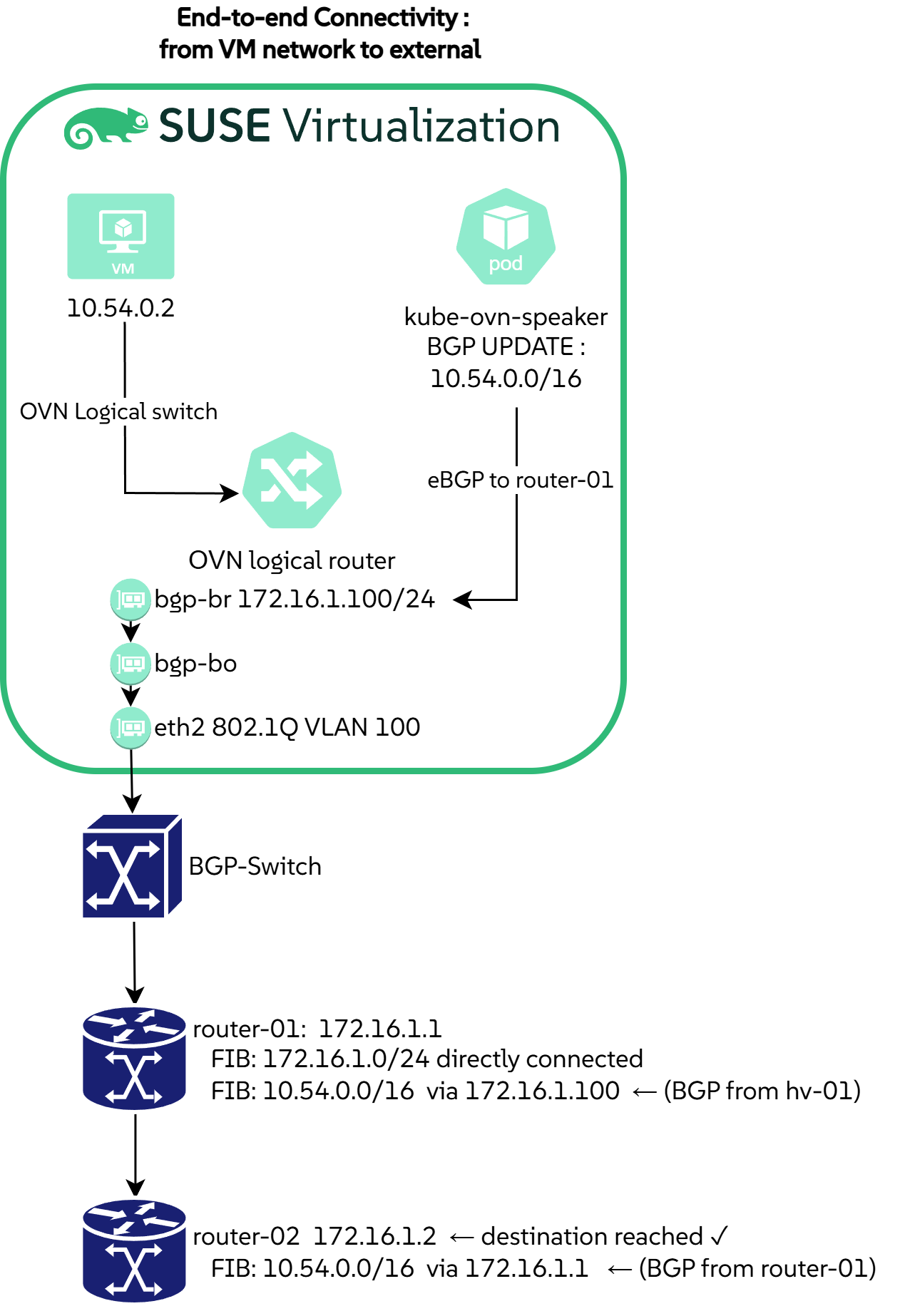
The diagram below traces a packet from a pod on hv-01 all the way out to router-02, showing every hop where a BGP-learned route comes into play :
# On hv-01 - confirm what the speaker is announcing (and receiving)
kubectl -n kube-system exec -it \
    "$(kubectl -n kube-system get pod -l app=kube-ovn-speaker -o name | head -1)" \
    -- gobgp global rib

# On router-01 - Kube-OVN prefixes should appear via 172.16.1.100
show ip bgp

# On router-02 - same prefixes, next-hop via 172.16.1.1 (transitive)
show ip bgp

# End-to-end - from router-02, reach a pod IP directly
kubectl run nginx --image=nginx && kubectl get pods -o wide
ping <POD_IP>   # from router-02, proves full transitive propagation
Conclusion
Once VLAN trunking and MAC spoofing are sorted on the Hyper-V side, Kube-OVN's BGP speaker on Harvester behaves like any other upstream BGP peer.
Further reading
- Kube-OVN BGP support
- VyOS BGP configuration guide (sagitta)
- Harvester networking deep-dive
- rrajendran17/KubeOVN-BGP : similar setup using FRR as the external router