Following a Packet Through OVN on KubeVirt, and Why I Built kvovn-topo
If you come from the VMware world, your Software-Defined Network is NSX. Its open source counterpart is Open Virtual Network (OVN). OVN is a solid foundation, and you find it in most hypervisor alternatives to VMware : OpenStack and, obviously, KubeVirt.
On Harvester , the kubeovn-operator addon brings Kube-OVN on top of OVN : VPCs, subnets, NAT gateways, EIPs. Connecting a VM to a VPC is easy enough. Knowing what happens to its packets is much harder.
I hit a few networking bugs on Harvester, and fixing them was the easy part. Most of the time went into finding where the packet went.
Why a packet path is hard to follow
Your usual tools stop working
On a classic hypervisor, you ping, you tcpdump the bridge, you read the routing table. With OVN, the routers and switches are not interfaces. They are logical objects, compiled into OpenFlow tables inside Open vSwitch on every node.
A packet dropped by a logical flow never reaches a virtual interface. There is nothing to capture. The VM's tap device stays silent, and ip route on the node tells you nothing about the VPC.
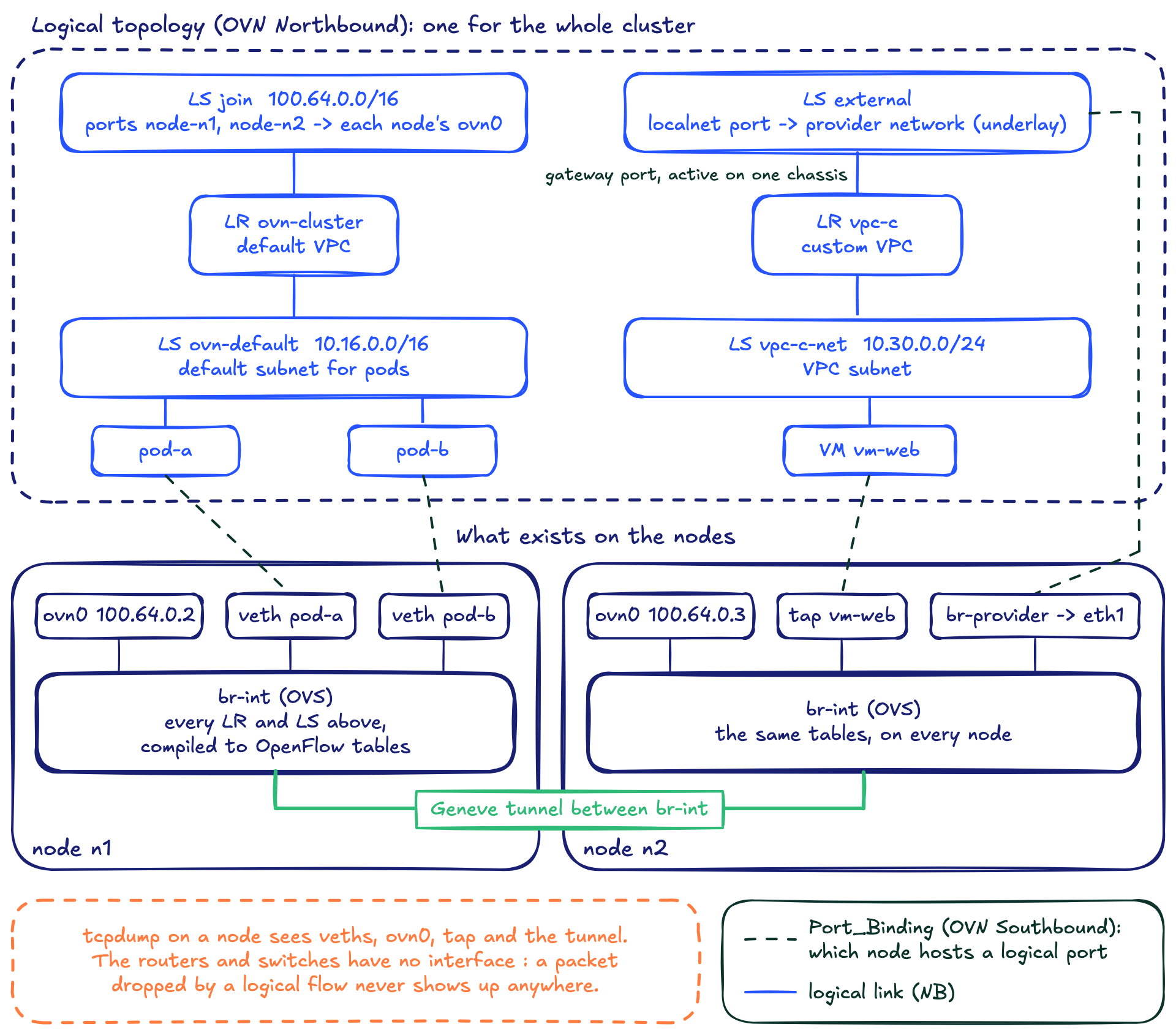 One logical topology for the whole cluster. The
join switch connects the default VPC to every node through ovn0, and the external switch reaches the underlay through a localnet port. On the nodes, all of it is OpenFlow tables in br-int.
On classic Kubernetes, I reach for netshoot , a container packed with tcpdump, dig, iperf and friends. It is not enough here either : it sees one network namespace at a time, not the logical pipeline OVN runs between them.
Every layer renames things
OVN has its own vocabulary. Kube-OVN puts its own abstractions on top, and ovn-kubernetes has different ones.
| Concept | Kube-OVN | OVN | ovn-kubernetes |
|---|---|---|---|
| Virtual router | Vpc |
Logical_Router |
ovn_cluster_router, GR_<node> |
| Virtual switch | Subnet |
Logical_Switch |
node switch, UDN |
| Source route | policySrc static route |
Static_Route policy=src-ip |
no CRD |
| NAT to the outside | VpcNatGateway (a pod) |
nothing : iptables in the pod | local gateway mode : the host stack |
The NAT row caused the bug later in this post.
The configuration is scattered
The OVN Northbound database (NB) holds the intent : routers, switches, routes, NAT. The Southbound database (SB) holds the reality : which chassis bound which port. The two are joined only by names.
Then the CNI adds its own layer. Kube-OVN CRDs describe the desired state, and a failed reconcile looks perfectly correct. Some state lives in neither database, but in iptables inside a pod. No single tool showed me all of it, down to the pod or VM at the end of the wire.
What I wanted : two things
I started kvovn-topo with two goals.
1. See how the objects are organized. Routers, switches, logical ports, chassis, down to the running pod or VM. NB and SB joined into one live graph, with Kubernetes names on top.
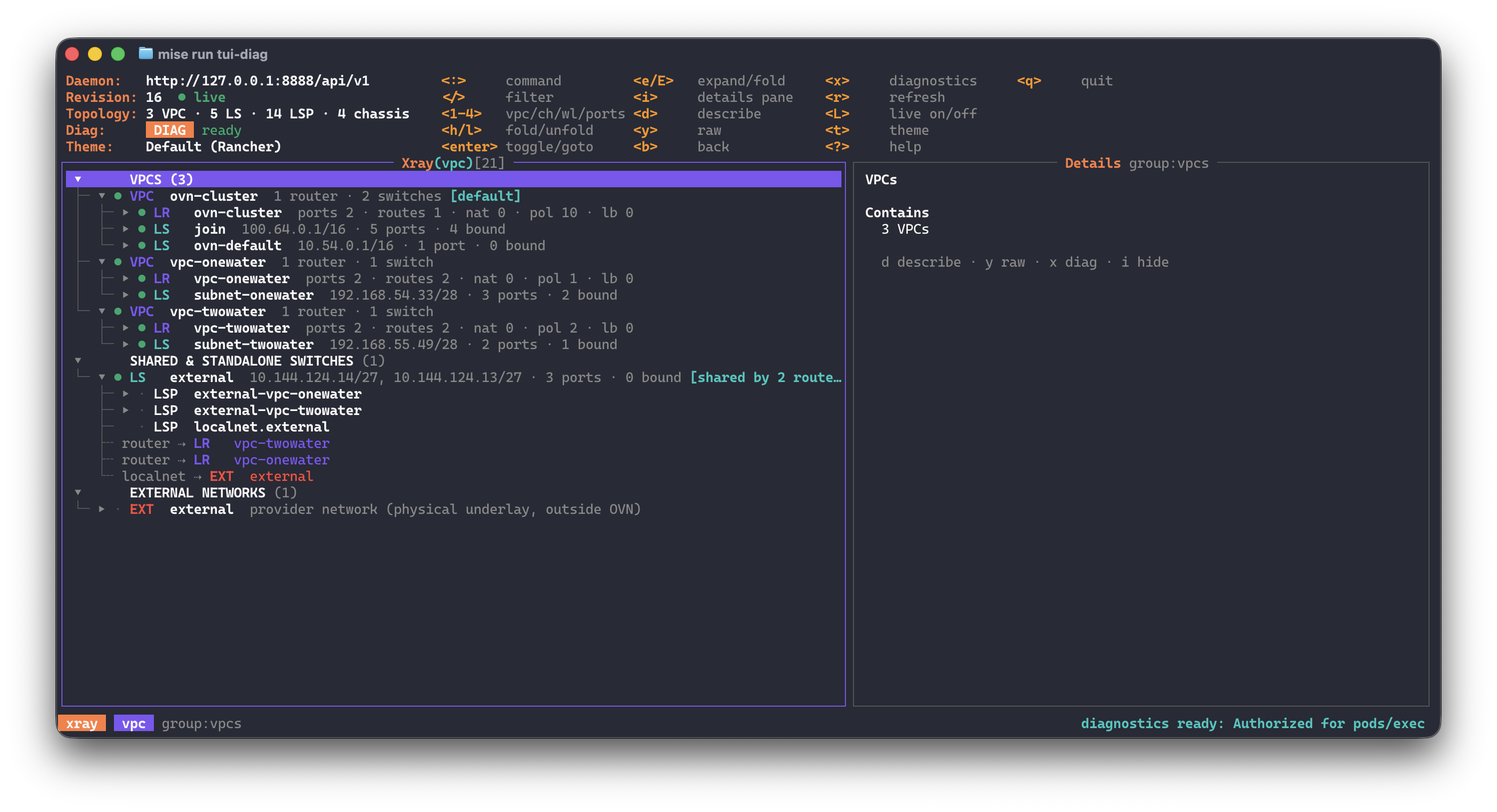 The VPC tree : each VPC with its router and switches, plus the shared external switch and the underlay.
2. Trace and debug without twenty commands. Finding the right node, the right OVS interface and the right container eats the time. So the diagnostics are contextual. Select an object, press x, and kvovn-topo runs ovn-trace, tcpdump, the OVS conntrack table (ovs-appctl dpctl/dump-conntrack) or ovn-controller logs for that object, on the node that hosts it.
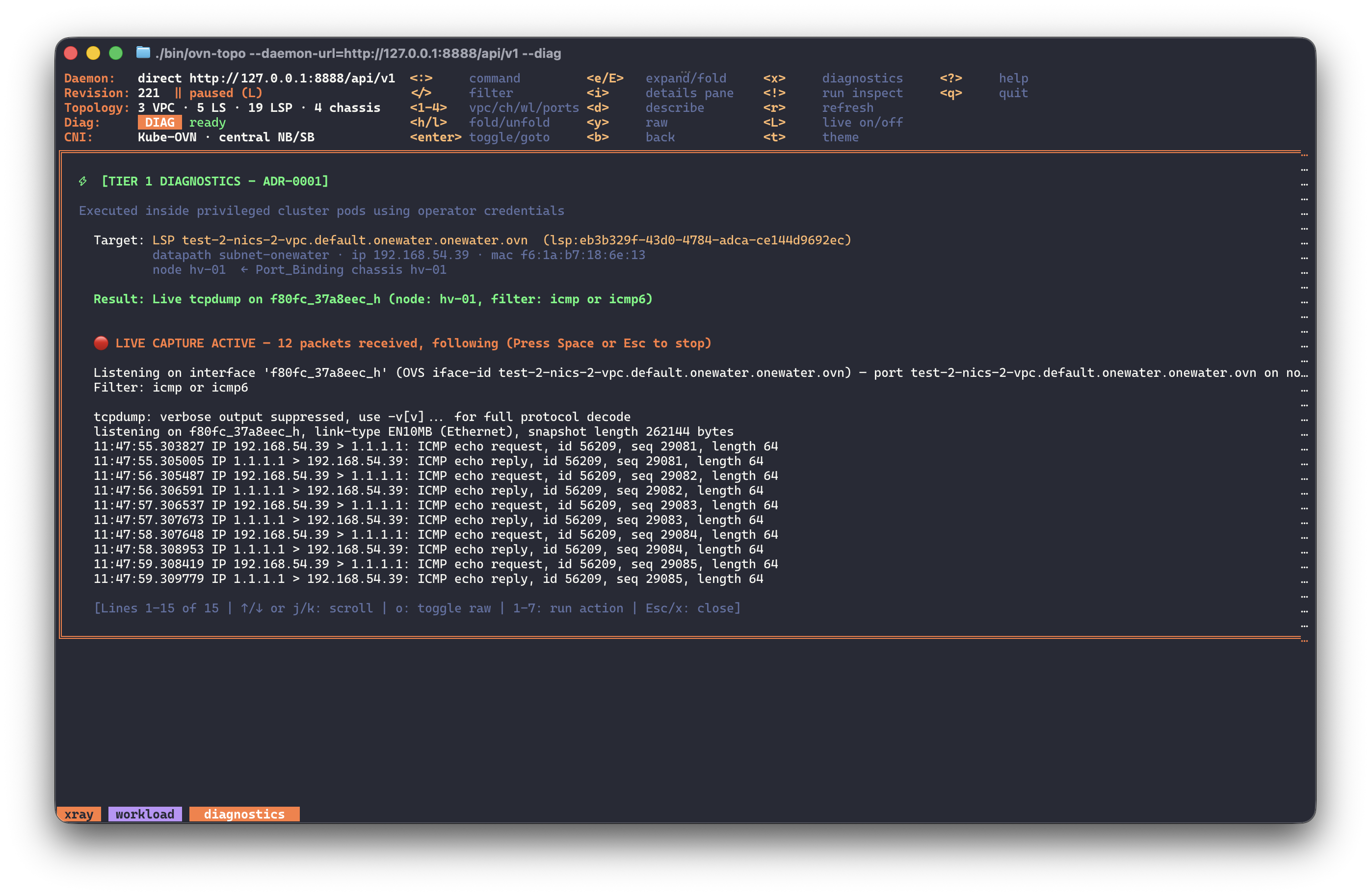 A live tcpdump on a VM's port : the tool resolved the OVS interface and the node from the Port_Binding.
The same graph is also exposed to AI agents, more on that below.
A few hard design rules, given to the coding agent, made the tool safer :
- Read-only. It reads OVSDB directly and never writes. OVSDB has no read-only role, so read-only is enforced in code and by a lint rule in CI.
- Kubernetes only for names. The topology comes from OVN. Kubernetes only maps chassis to nodes and ports to pods and VMs.
- Passive by default. The exec-based diagnostics need
--diagandpods/execRBAC. Without them, the tool only observes. - No exposed endpoint. The client reaches the daemon through the Kubernetes API service proxy.
The packet OVN never saw
Here is an actual "bug", or rather a Kube-OVN misconfiguration, that kvovn-topo helped me solve. I rebuilt it as a lab scenario with simpler names and IPs.
A custom VPC vpc-c has two Kube-OVN VPC NAT gateways :
gw-out(LAN IP 10.30.0.254) takes the VPC's0.0.0.0/0route and SNATs outbound traffic.gw-in(LAN IP 10.30.0.253) DNATs port 8080 on its EIP to the VMvm-web(10.30.0.10).
The symptom
Inbound connections to 8080 hang. The SYN reaches vm-web, so DNAT works. The connection never completes.
OVN says everything is fine. The route table is short and sane, and the NAT table is empty :
$ kubectl ko nbctl lr-route-list vpc-c
IPv4 Routes
Route Table <main>:
           10.30.0.0/24                10.30.0.1 src-ip
              0.0.0.0/0              10.30.0.254 dst-ip
$ kubectl ko nbctl lr-nat-list vpc-c
$
Yet this VPC does NAT twice.
What was really happening
A VPC NAT gateway is a pod. Its EIPs, DNAT and SNAT rules are iptables inside that pod. OVN sees two ordinary logical switch ports and nothing else.
The request goes in through gw-in. The reply from vm-web reaches the router vpc-c, which knows nothing about that DNAT.
The router sends the reply along 0.0.0.0/0 to gw-out. gw-out has no conntrack entry for the flow and SNATs the reply to its own EIP. The client expected an answer from gw-in's EIP, so it drops the packet. That is an asymmetric return.
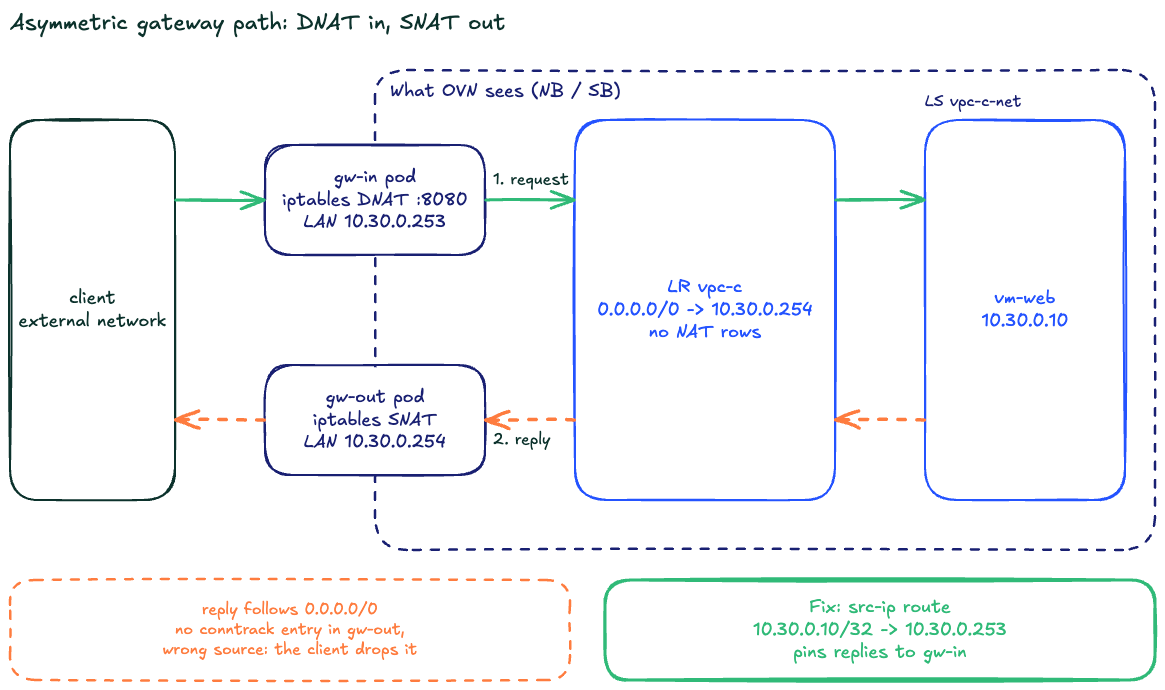 Both gateways are half outside OVN's view. The router routes the reply by destination, and nothing pins it back to
gw-in.
The fix
One src-ip route that pins replies from vm-web back to gw-in :
apiVersion: kubeovn.io/v1
kind: Vpc
metadata:
  name: vpc-c
spec:
  namespaces: [vpc-c]
  staticRoutes:
    - cidr: 0.0.0.0/0
      nextHopIP: 10.30.0.254   # gw-out, default egress
      policy: policyDst
    - cidr: 10.30.0.10/32
      nextHopIP: 10.30.0.253   # replies from vm-web go back through gw-in
      policy: policySrc
OVN picks the longest matching prefix across dst-ip and src-ip routes. A /32 source route beats 0.0.0.0/0, so the reply goes back through the gateway that translated the request.
What kvovn-topo does with it now
NAT gateway pods now show up as an "Outside OVN" hop on their router. With --diag, ! runs iptables-save -t nat inside the gateway pod.
The Problems view (key 4) also flags the pattern :
! LR   vpc-c  replies may bypass NAT gateway gw-in: 0.0.0.0/0 goes to 10.30.0.254
              and no src-ip route or reroute leads to 10.30.0.253 (heuristic)
It flags gw-in and not gw-out, because the default route already leads to gw-out. The check is labeled heuristic : without exec, the tool cannot know whether gw-in actually DNATs anything.
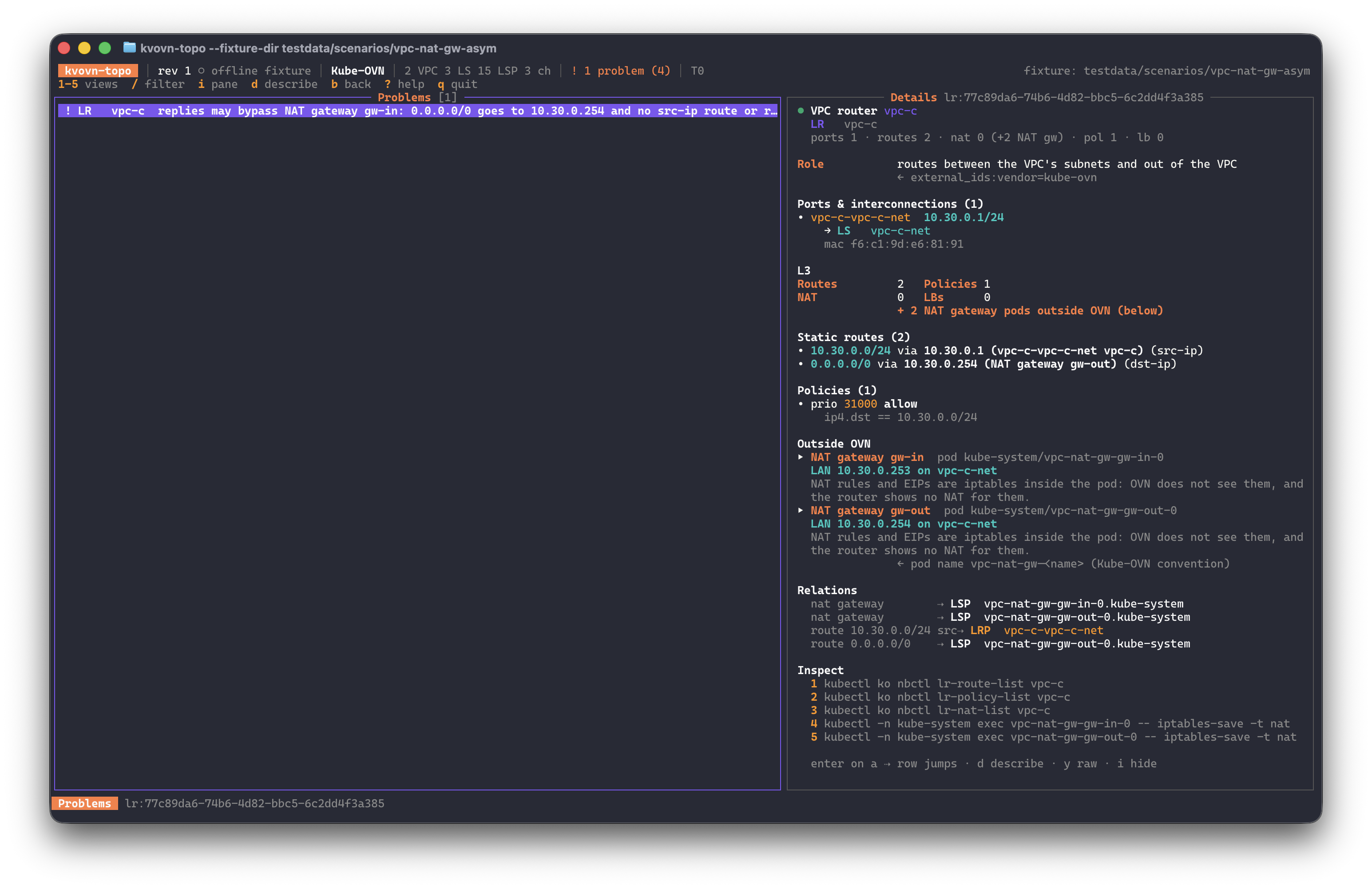 The Problems view on the
vpc-nat-gw-asym scenario, with the router's details on the right.
Know which hops your SDN cannot see
The VPC NAT gateway is not the only place where traffic leaves OVN's view :
- Kube-OVN VPC NAT gateway : iptables inside a pod.
- Kube-OVN default VPC with
natOutgoingin centralized mode : a policy reroute plus iptables on the gateway node. - ovn-kubernetes local gateway mode : traffic goes through the host network stack via
ovn-k8s-mp0.
In each case lr-nat-list comes back empty while NAT happens.
Sidenotes
Ask an agent : kvovn-topo mcp
kvovn-topo mcp is an MCP server over stdio. It gives an AI agent four read-only tools on the same graph as the TUI : find, get_graph, get_node and list_chassis. Plugging it into Claude Code is one line :
claude mcp add kvovn-topo -- kvovn-topo mcp
Then ask in plain words. Here I asked OpenCode, running Gemini 3.5 Flash, for a status check of my lab cluster. It went through the routers, policies and port bindings, and came back with a report.
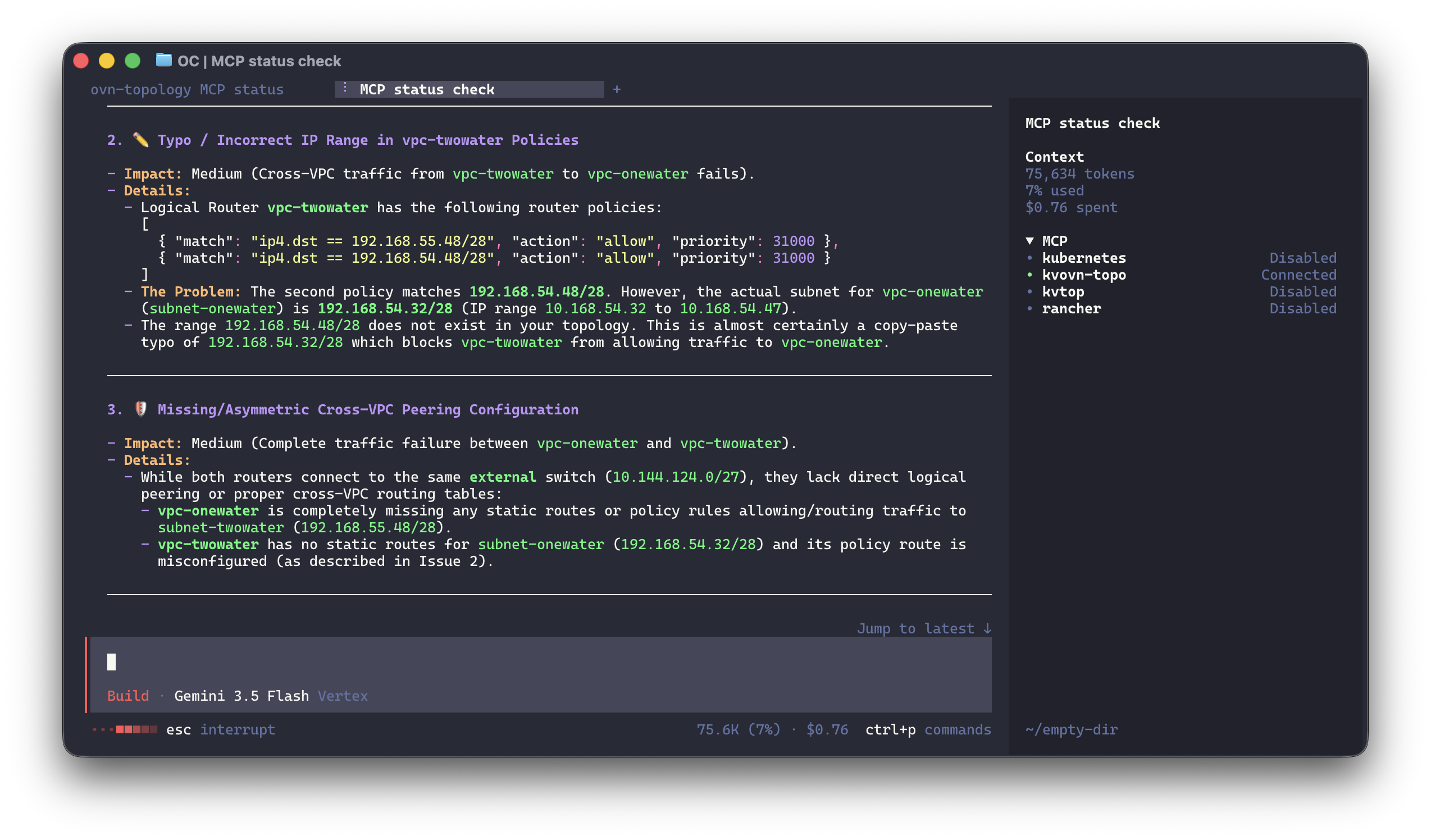 The agent spotted a policy that matches a subnet that does not exist, and two VPCs with no routes to each other.
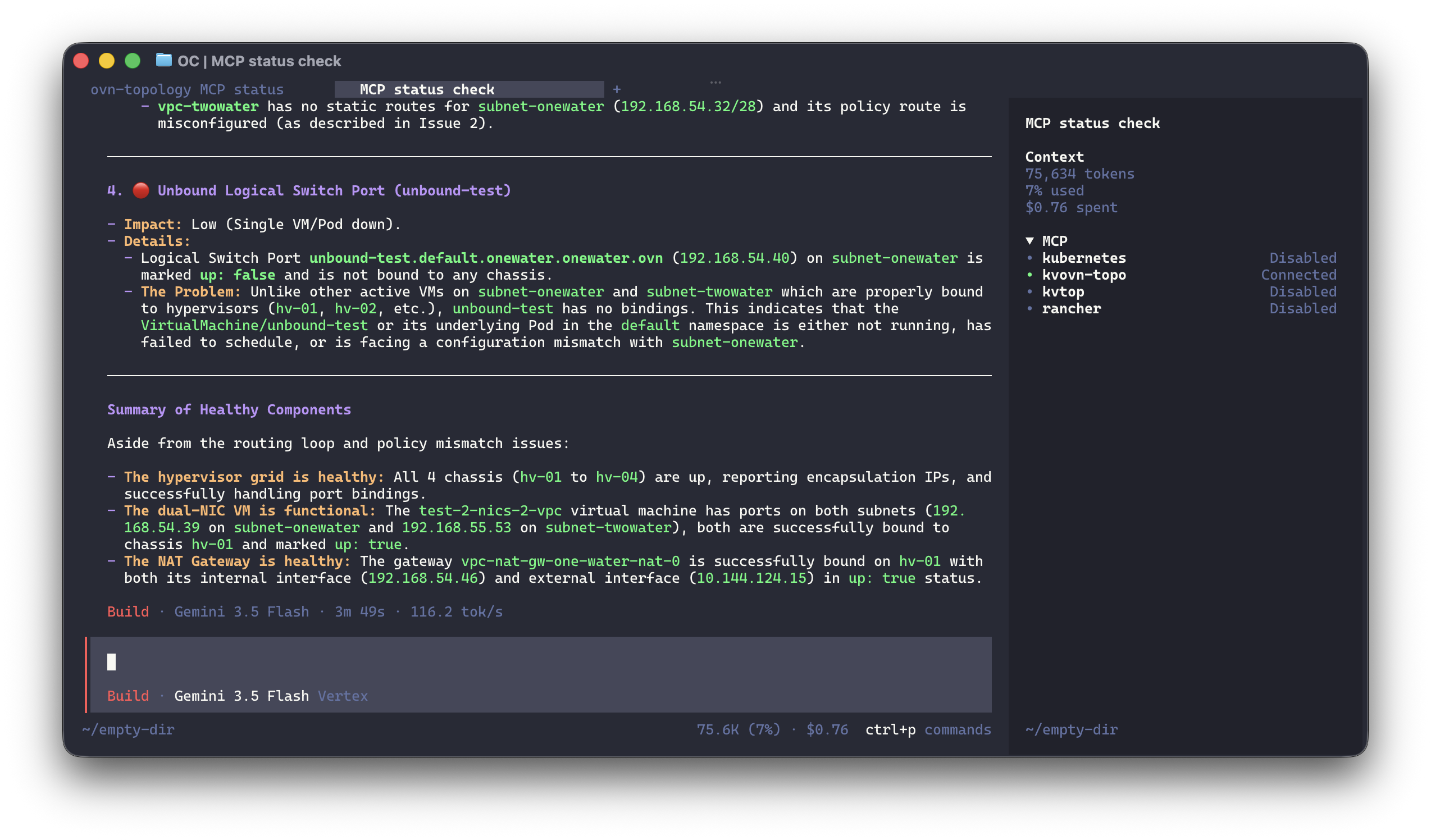 It also flagged an unbound port, and listed what was healthy : chassis, a dual-NIC VM and the NAT gateway.
The MCP server never runs the exec-based diagnostics, even with --diag.
Kube-OVN v ovn-kubernetes, one OVN, two control planes, two designs
Kube-OVN and ovn-kubernetes both drive OVN but they took very different paths.
Kube-OVN keeps a classic design : a central kube-ovn-controller and one central NB/SB pair. You read the whole topology from one place.
ovn-kubernetes moved to interconnect mode with OpenShift 4.14. Every node is its own zone, with its own NB, SB and northd, listening only on a local unix socket. There is no central database. Each zone holds a near-complete copy of the cluster's logical objects, and a transit switch with remote ports stitches the zones together.
When I connected kvovn-topo to an OpenShift cluster, the first thing it said was no such host : there was no NB service to connect to.
The two designs need different collectors on top of the same OVN core. kvovn-topo keeps the CNI-specific parts behind a flavor adapter, and today it reads one ovn-kubernetes zone at a time. A merged, cluster-wide view is designed but not built yet. More on that in a later post.
Try it
Pre-release
The commands below point to kvovn-topo v0.1.0.
Install the daemon in the cluster (RKE2 or Harvester) :
helm install kvovn-topo oci://ghcr.io/coulof/charts/kvovn-topo --namespace kube-system
Install the client on Linux (amd64) or macOS (arm64) :
VERSION=0.1.0
OS=$(uname -s | tr '[:upper:]' '[:lower:]')
ARCH=$(uname -m | sed 's/x86_64/amd64/;s/aarch64/arm64/')
curl -fsSL https://github.com/coulof/kvovn-topo/releases/download/v${VERSION}/kvovn-topo_${VERSION}_${OS}_${ARCH}.tar.gz | tar -xz kvovn-topo
sudo install kvovn-topo /usr/local/bin/
Conclusion
kvovn-topo is my most ambitious vibe-coded project so far. I believe it will help SUSE Virtualization and OpenShift users, whether they run diagnostics by hand or through an agent.
I would love community feedback on this one. Poke me directly or open an issue on GitHub . The next big step is to bring the debugging tools into a Rancher UI extension .
Further reading
- kvovn-topo on GitHub
- ADR-0004 : CNI flavors and opaque hops , the design behind the NAT gateway check
- ADR-0005 : ovn-kubernetes interconnect
- Harvester VPC NAT gateway and Kube-OVN gateway options
- Kube-OVN VPC configuration and static routes
- How the new OVN-Kubernetes architecture helps with scaling OpenShift